1) How did communities of color in the U.S. react to the Viet Nam War?
2) What was the global and domestic impact of the Viet Nam War for "Third World Movement" and related social-political movements?
3) What is the legacy of this period and the activists involved?
Jason Luong:
"About Face: Recognizing Asian & Pacific American: Vietnam Veterans in Asian American Studies" by Peter Kiang
Accounts regarding the experience of the Viet Nam War have been documented through various sources such as media coverages and post-war interviews, articles and published books as well as oral stories and personal journals. However, these documentaries from minority groups connected to the war are limiting and left mostly unexplored. In particular, the Asian American veteran experience is severely lacking in open content. Peter Kiang, in his article “About Face: Recognizing Asian & Pacific American: Viet Nam Veterans in Asian American Studies”, addresses this disproportionate material by dissecting and discussing similarities and differences between the Asian experience to the experiences of other ethnic groups. While Kiang states that while “the overlap in these stories with those by non-Asians suggest that there are bonds and experiences shared by Viet Nam veterans, independent of race and ethnicity” (26), yet also mention degrees of which one’s moral and self identity are placed under a wider public context to the war itself. Accounts vary between the dehumanization of the Vietnamese in general, not just the enemy soldiers, to be use and misidentification of one’s identity as distressing to soldiers who identify under the pan-ethnic Asian group. One Chinese American soldier’s account relays how he, amongst many others in similar situations, relied on other individuals of other colored groups as a survival tactic. As noted by Kiang, many colored racial/ethnic groups shared a stronger bond due to shared experiences of racial discrimination amongst the ranks; in contrast, he noted that attempts at relating oneself to Whites became problematic at times and often failed to due increasing stress due to the prevailing racism. Kiang further relates this issue to that of post-traumatic stress disorder, or PTSD. Studies such as the National Vietnam Veterans Readjustment Study reveal recorded minorities such as African American and Hispanic American veterans suffered degrees of PTSD approximately ten to fifteen percent higher than their Anglo-Saxon counterparts. Asian ethnic groups are recognized to share similar percentages, “given regular confrontations with racism combined with isolation and alienation resulting from being the only Asians in their units” (32). For veterans in the API community, mixed feelings of just human and, additionally, pan-ethnic empathy contrast with resentment to the Vietnamese became prevalent during wartime and post-wartime. Due to the rise of ethnic minority self-appreciation and the strive for equality back home before and during the war, soldiers of minority status often found themselves unable to dehumanize an enemy who is fighting for similar causes, but on opposing sides. Kiang states that, for those that resent the Vietnamese or, at least, the Vietnamese soldiers of the other side often hold these feelings as they place the blame of them for the poor treatment of the API community by their own peers/colleagues. Finally, Kiang relates social-political movements during the post-Viet Nam War years for the API community as part of their healing process for their experiences during the war; he states that “[Many] communities of color throughout the country mobilized opposition to the war and made connections to racism and freedom struggles at home” (33). He finalizes his report with a discussion on how these movements and post-war returns have impacted this community. Many, in the decades following the end of the conflict, found themselves reassessing themselves back into their home in America. Relations with the Vietnamese, in and out of the war, subjectively good or bad, shared by physical, cultural, or simply human traits, enabled movements in recent years to address what Kiang states as the “reality of marginality”, or lack of perspective, of the Asian American experience, both at home and overseas in war.
suggested links and imagery:

- http://www.blogs.va.gov/VAntage/14181/asian-pacific-american-veterans-an-american-story/
- http://www.ptsd.va.gov/professional/treatment/cultural/ptsd-minority-vets.asp
"Disappeared Men: Chicana/o Authenticity and the American War in Viet Nam" by John Alba Cutlersuggested links and imagery:

- http://www.blogs.va.gov/VAntage/14181/asian-pacific-american-veterans-an-american-story/
- http://www.ptsd.va.gov/professional/treatment/cultural/ptsd-minority-vets.asp

As with many minority groups within the ranks of the American side during the Viet Nam War, the Chicano experience is not well-documented nor prevalent in most mentions of historical accounts on the conflict. However, where official statements lack in terms of representation, personal tales make up for the demographic who participated, in some form, during this era of war. John Alba Cutler's “Disappeared Men: Chicana/o Authenticity and the American War in Viet Nam” makes note, however, that these accounts reflect a series of domestic issues rather than a personal reflection of a war across the Pacific. Cutler firsts revisits the introduction, or rather reintroduction, of these documentaries as outside the mainstream representations of the war; he suggests that the centrality of the wartime protest and postwar tensions revolved around the loss of masculinity and power. With mentions to novels Motorcycle Ride and Gods Go Begging, he suggests that, while most anti-war and ethnic-empowered movements reached a complex standard, the issue of the Chicano experience, while limited and biased in terms of gender studies, is rather unique in the sense that representation of this issue, “those complexities . . .
underwritten the movement from the beginning” (585). The use of “disappeared men” becomes apparent in recognizing the morality of the war for this community as with the general broadcast of the atrocities of the war for many groups of color. As with many other groups, the Chicano involvement and death toll represent an undisclosed and often overlooked statistic that helped form the basis for their, the community’s, position on the anti-war protests such as the East Los Angeles high school blowouts of 1968,the first Chicano Youth Liberation Conference in 1969, and the Chicano Moratorium marches (586). Rather than approach this issue directly with open disapprovement, the issue of masculinity is a conflict between what Cutler defines as an issue between “eschewed assimilationist patriotism and radical resistance” (587). He suggests that authenticity is questioned from the beginning with traditional views of empowerment as a patriot conflicts with the presentation of a male protester as warrior-like. The image below, Malaquías Montoya’s1973 poster “Vietnam-Aztlán Solidaridad” mentioned by Cutler, “note that the poster links Vietnamese and Chicano struggles by juxtaposing not two soldiers but a North Vietnamese Army (NVA) soldier with a Chicano protestor” (587); Cutler relates not soldiers of the Viet Cong to the patriotism of Chicanos fighting a war, but to similarities of status and socioeconomic positions of their respective countries. Cutler continuously makes note in the belief that similarities of the struggles of the Vietnamese ties with the historical and post-war/current struggles of this community, but also suggesting the paradoxical nature of the Chicano post-war movements with traditionalist views of the community, inviting the belief that this point of view is problematic towards understanding the whole community. One of the two novels mentions by Cutler, Motorcycle Ride, in Cutler’s words, “suggests that Chicano masculine assimilation can be traumatic, and male desire dangerous” (601). This mention is important as it alludes the problems that postwar assimilationists faced returning to families and expecting akin to more traditional styles of living, good or bad. As suggested “The scenes [of domestic violence] . . . can be an instance of a local history confronting global designs” (606). These narrations from what Cutler believes to be warnings of the embracement and retreat to dangerous stereotypes for both male and female Chicano/a relations to the community and the world. This novel overall presents the issue of family/community reformation and traditional culture with the desire for masculine input as shifting with the need of self-awareness and understanding of all parties. The violence depicted ties into the disillusionment felt by the entire Chicano community, of domestic violence, of separation and personal interests.

"On Vietnam and World Revolution" by Che Guevara
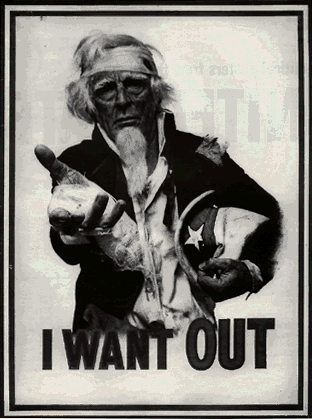
After experiencing two World Wars and the tensions and conflicts of the Cold War era, The US’s international policies shifted drastically. Che Guevara, an Argentine Marxist revolutionary and a major figure from the Cuban Revolution, in his essay “On Vietnam and World Revolution”, wrote and critiques American involvement on post-WWII conflicts as part rallying the audience to Guevara’s words on US imperialism. He first relates US involvement in other parts of the world such as the motion against Japan during the last years of the Second World War, to the Korean conflict where “,under the deceptive banner of the United States, . . . [the] utilization of the conscripted south Korean population as cannon fodder” occurred. With Viet Nam, Guevara finalizes his thoughts on how the the US failed to completely make use of its prior application of indirect imperialism through the use of the local population; its bitterness resulted in a massive reorganization that included the lack of recognition for the Geneva accords dividing the nation, attempts at installing a puppet government loyal to American benefits, and the increased use of thermonuclear and biochemical weaponry. However, what Guevara suggests, is not necessary favoritism towards Communism, but rather, an escape from the binds of two major superpowers that have emerged from the Second World War. Rather than present the reactions of intended communities of color to these actions, Guevara imposes a question to those empathizing with the conflict; He asks: “Is Vietnam, isolated or not, doing a dangerous balancing act between the two disputing powers?” (6). He applies the conflict in Viet Nam as an example of the US’s peak of imperialism across the world; it is left limited to airstrikes and, essentially, forceful aggressions against what Guevara calls “freedom movements” with media cover-ups and “slogans such as ‘We will not permit another Cuba” (7). Guevara finishes his initial report on the legacy of this war in Viet Nam as a conflict that only permits a broken revolution with pro-imperial support or self-recognition against major Western powers; he is not only taking note on the nations of Asia as only a fight those of only Asian background deserve to become invigorated, but for all disenchanted groups of color. Guevara’s goal, in this essay, ultimately is to rally “the exploited of the [current state of] the world (6), minority communities of all kinds who felt sympathy for this nation into action; in his words, “Vietnam, a nation representing the aspirations, the hopes for victory of the entire world of the disinherited, is alone” (5). In this sense, Guevara almost accurately predicted the world’s current views of imperialistic policies years after his passing. He states:
- Asia is an “explosive region” of exploited resources for all interested parties.
- The Middle East is a “boiling” region of a Cold War-like conflict of two states: the US (imperial)-supported Israel and whom he calls “the progressive countries of this zone”.
- Africa is becoming a victim of a “neo-colonial/neo-imperial invasion”
He suggests that, like Viet Nam, the opportunity of escape for nations bound to imperialistic rule or aggression from larger nations lies in the failures presented by the US; the facade of coming in to another country is waning in popularity as new of war atrocities, the use of open warfare without criticism, is over for Western imperialist powers. In conclusion, Guevara seeks to end such imperial rule with the standards set by nations such as Viet Nam, where the international US policies of his time did not result in a victory for US capitalism and progression; he means to create second or third Vietnam-like nations, reminding people of his issue involving the Cuban revolution, and reminding others that imperialism is worldwide, and should be met with worldwide resistance (11).
Suggested link and source of images:http://www2.iath.virginia.edu/sixties/HTML_docs/Exhibits/Track16.html#Poster
Victoria Vergara:
"Internal Colonialism and Ghetto Revolt" by Robert Blauner

http://eyeswideshut20.blogspot.com/
1) Racial group enters into the dominant society. Colonization begins with a forced, involuntary entry.
2) The colonizing power carries out a policy which constraints, transforms, or destroys indigenous values, orientations, and ways of life.
3) Colonization involves a relationship by which members of the colonized group tend be administered by representatives of the dominant power. There is an experience of being managed and manipulated by outsiders in terms of ethnic status.
4) Racism is a principle of social domination by which a group seen as inferior or different in terms of alleged biological characteristics is exploited, controlled, and oppressed socially and physically by a superordinate group.
Basically, to sum up the four components listed by Blauner, colonization is when a minority group gradually becomes a part of the dominant society. There an abundance of ethnic groups that live in America, however, there are distinct features that show the colonized status of the Black ghettoes. Ethnic ghettoes, as Blauner puts it, voluntarily chose to immigrate to America and inevitably were to live among one’s fellow ethics. Second, they have to assimilate to the dominant group. Often, the Black ghetto has been a more permanent phenomenon claims Blauner. Unlike the Black ghetto, other ethnic groups such as the Poles and Italians only experience a brief period since they weren’t destroyed by slavery and internal colonization. The administration by outsiders of the Black community who administer the affairs of the ghetto resides are typically white. So, in order to attack domestic colonialism in America, riots, programs of separation, politics of community control, and the Black revolutionary movements are all being executed. In riots, rioters want “to join America’s middle-class affluence just like everyone else.” By using signs, rioters hope to destroy the symbols of oppression and move against the society that they feel somewhat threatened by due to their superiority. The initiation of riots implies that the will to resist has broken the mold of accommodation—meaning that they refuse to assimilate. Blauner talks about how Frantz Franon described how “the assimilation-oriented schools of Martinique taught him to reject his own culture and Blackness in favor of Westernized, French, and white values.” With the Western culture, they are seen as having prestige and power that the colonized don’t have, however, they could achieve this. However, this is seen as brainwashing to the Black Muslims and even seen as identifying with the aggressor in Freudian terminology. Anti-colonialists want to take over business, social services, schools, and the police department. According to Blauner, African Americans are demanding their own schools boards in order to have the ability to hire and fire school staff and to construct a curriculum that’s relevant to the needs of the ghetto youth. “Black Power” programs hope to buy property and business and run schools in order to “serve to revitalize the institutions of the ghetto and build up an economic, professional, and political power base.” Freedom for the colonized have a choice of either participating and yielding themselves to the larger society/superordinate, or building their own independent structures.
"Declaration of Independence from the War in Vietnam" by Martin Luther King, Jr.
https://www.youtube.com/watch?v=b80Bsw0UG-U
Martin Luther King, Jr. addressed the population regarding his thoughts on the Viet Nam War. People questioned his actions as to why he was “joining the voices of dissent” since peace and civil rights don’t really mix. King mentions that during the time of the Civil Rights movement while they are trying to fight for justice for African Americans, the U.S. government would send blacks to fight in Vietnam when they cannot even find jobs or justice for them at home. Since the Viet Nam War was the first war to ever be televised, King says that it’s cruel to watch “Negro and white boys on TV screens as they kill and die together for a nation that has been unable to seat them together in the same schools.” In a way, as I was reading this, I began to critically think of how the U.S. government was selfish to sacrifice their soldiers to kill the Vietnamese (Viet Cong) in way to prevent communism. However, that wasn’t really the case. The U.S. government saw Vietnam being unfit to stand alone, or to be independent. Due to the “deadly Western arrogance,” Vietnam was denied the right of independence.
In his speech, King also makes a comparison. The Americans in Vietnam were similar as to when the Germans were in Europe, where they tested new medicine as well as tortured many in the concentration camps of Europe. Following that, he defines the true meaning of compassion and non-violence and somehow in a sense wishes to apply that to the U.S. in hopes of acquiring these traits. In order for them to do that, King said that the U.S. would have to see the enemy’s point of view, to hear their questions and concerns, and to assess themselves appropriately. King not only shows concern for the Vietnamese but he also expresses his concern of our own American troops. Submitting them into Vietnam to fight a brutal war, to fight for actually “none of the things” that the U.S. has claimed to be fighting for, was all wrong. King says, that “this madness must cease.” In order to do this, he lists five suggestions of how to extract themselves from this war:
1) End all bombing in North and South Vietnam.
2) Declare a unilateral cease-fire in the hope that such action will create the atmosphere for negotiation.
3) Take immediate steps to prevent other battlegrounds in Southeast Asia by curtailing our military build-up in Thailand and out interference in Laos.
4) Realistically accept the fact that the National Liberation Front has substantial support in South Vietnam and must thereby play a role in any meaningful negotiations and in any future Vietnam government.
5) Set a date on which we will remove all foreign troops from Vietnam in accordance with the 1954 Geneva Agreement.
King makes a reference to John F. Kennedy, where five years ago, Kennedy states “Those who make peaceful revolution impossible will make violent revolution inevitable.” This statement was made very visible and applicable during the Viet Nam War.
5 questions for class discussion:
1) In what ways does under-representation during overseas conflicts coincide with tensions back home? How have previous attempts to resolve these issues conclude?
2) In your personal opinion, how has relating wartime patriotism to masculinity, whether in general or ethnic-based, problematic?
3) What other methods have API members dealt with discrimination in the war, and how have these methods extended to relations back home?
4) How has social-political movements against either overseas conflict, racial discrimination, or both dealt with self-identity? Where do individual groups stand in light of American presence overseas?
5)How has assimilation both during the Viet Nam War and related conflicts overseas as well as at home become problematic after the war? How has it benefited involved groups?