1) What are some important connections between Southeast Asian countries and their diasporic groups?
2) What are some Southeast Asian American Intra-ethnic and Inter-ethnic strife and solidarities?
Questions for Class Discussion:
1) What are some ways Vietnamese Americans are doing to fight for political representation?
2)How have communication technology advances improved over the years? In what ways have this benefited many communities in terms of social change?
3)In what ways have music provided us a way to reconnect with ourselves and our ethnic group? Do you think music is taken for granted?
4) In what other ways not discussed in the readings can visual art create opportunities for solidarity?
In what ways can it inhibit that possibility for open dialogue?
5) What else can individuals do (that has not been attempted prior) to change the binary of the Vietnamese (communism/anti-communism, nationals/refugee, older/younger generation, etc.)?
Transnationalizing Viet Nam: Community, Culture, and Politics in the Diaspora by Kieu-Linh Caroline Valverde
Brian Vuong:
Chapter 1: Transnationalizing Viet Nam
Chapter 1 starts when Valverde explains the term diaspora : this term can sometimes have a negative connection to the "motherland' especially when the diasporas and the homeland don't have a good relationships. Nakanishi argues that the movement of refugees and immigrants are heavily depend on international politics of where the refugees and immigrants come from. The addition of Vaverde's diaspora definition is that included that hybrid cultures of the homeland and adopted country where the refugees and immigrants stay. Next, Valverde explains little bit about how Vietnamese Americans are in the US by 3 waves : wave 1 is for who work for US during the Viet Nam war, wave 2 is for the "boat people" who lived under the new united Viet Nam and find its difficulty and want to escape, wave 3 is for the former South Viet Nam military personnels who went to 're-education' camp under the North Communist government of Viet Nam, the program also called HO "Humanitarian Operation". She argue that Vietnamese American don't assimilate to the US's culture fast enough so they are treated unfairly. Some younger generation of Vietnamese Americans used their fathers or grandfathers' experiences and turn into art such as independent film, art works, memoirs. All 3 waves of Vietnamese Americans experience different feeling of displacement. Valverde stated that : " For 75-er, displacement meant losing the nation...For the boat refugees, they carry with them years of discrimination in Viet Nam, trauma from escape and camp experience...For HO members, some forms of oppressions remain strong in the US, Young generation experience internal struggles include the legacy of their parents' loss and discrimination in a racist new home." After 1975, the diaspora still reserve the culture of South Viet Nam nation. For them, they are either anti-communist or communist. In many ways, it's unclear about the idea of anticommunism. After resettlement in new home, Vietnamese refuguees created few organizations with the hope of taking Viet Nam by force, protest, etc. The examples are NUFLVB National United Front of the Libration of Vietnam, Viet Tan. Viet Tan's focus on spreading democratic ideas and multiparty system and influenced US policy on human rights in Viet Nam. In chapter, Valverde also mentions about Duong Trong Lam, other individuals who were not really Communist agents, but have opposite ideas of anticommunist organizations. They got hated and protested by those anticommunist organizations for 'connecting Vietnamese diaspora and the Vietnamese government'. Starting around 1998, The Vietnamese government started to welcome "Viet Kieu" coming back to Viet Nam to bring up the economics and bring Viet Nam closer to globalization. "Viet Kieu" are also who they called "My Nguy" or traitors after the war ended. In Valverde's case study, she interviewed 150 people in Viet Nam and 100 people in the US from 1993 to 2012 analyzing all the topics of chapter 2,3 4.

Source : http://www.datviet2.com/attachment.php?attachmentid=3241&d=1324309072
Pahnia:
Chapter 2: Popular Music: Sounds of Home Resistance and Change
As chapter 2
of the book Popular Music: Sounds of
Resistance and Change discusses some of the important connections between
Southeast Asian countries and their diasporic groups involves popular music.
Before and after 1975, music has been a way to express themselves in their
lives and offer creativity and inspirations. As mentioned in the first couple
of pages of chapter 2, before the liberation of Vietnam, South and North were
two completely different sides. However, as one of the statements from a person
living in the South at the time, stated that when traveling to the North for an
official trip, he/she came to realized that Northerners were listening to Sai
Gon music since the early sixties and was aware of the famous Saigonese singers
in the South. To add on, he/she also mentioned that this was done in secret due
to North Vietnamese politics and government restrictions, “…because music has
no boundaries and politics, they were very interested in this kind of music.” As
the chapter later develops, music has in itself taken up a symbol of self identity
of different ethnic or social groups to redefine and reconnect back to their roots
after the 1975 exodus of refugees. Some producers carry with them cassettes and
music recordings to begin anew in the new place that awaits them. Once settled
down, those who were business owners in Vietnam became Vietnamese music
producers in America making cassette tapes and dubbing them to distributing
them into the French/American Vietnamese population. Many Vietnamese refugees connected well with
the music because it was not only just music to the ears but the type of music
that resonated and reflected their circumstances and the need to escape their
situation and lament their perceived glorious and glamorous past. As music was
a way to build connections to those back home and those in diaspora, there were
also complications and strife that prohibited the spread of music from the
Vietnamese American communities to the homelands. To consider, there were the
regulations from the U.S. and Vietnamese government that restricts trade across
boundaries as well as opposition that the music created are foreign influenced.
Despite all though, music was able to transgressed and be produced transnationally.
With time came loosened restrictions and tensions thus transportation, music,
and entertainment technologies have allowed artists to connect with people
abroad more frequently and have enabled them to listen to the different musical
developments in many more spaces like the internet.
https://www.youtube.com/watch?v=XpoZm3qSADA
(Pham Duy: The Rain on the Leaves)
Chapter 3: Social Transformations from Virtual Communities
This chapter
delves into the aspect of improved and ongoing technology that is highly
rendered in the United States and less in third world countries such as
Vietnam. After 1975, refugees who were displaced into various places had
obstacles of trying to find what ways to reconnect to those who were left
behind. Through the fast development of internet in the United States, forms of
communication became slow and steady in the still developing country of Vietnam.
However, with the diasporic of Vietnamese Americans in the U.S. and their intellectual
knowledge in computer and engineering, the link to providing more information
technology to Vietnam became an ongoing process that helps to improve
communication between the diaspora and homeland Vietnamese communities.
One of the
main components of this chapter was the creation of a transnational virtual
community called VN Forum created by Hoanh Tran and Tin Le. Through this
network, they were able to provide transpacific exchanges like training support
in the U.S. for some of the first Vietnamese computer engineer as well as
setting up companies with computer servers in Vietnam to help the Vietnamese
community connect to the rest of the world. In the start stage of internet
servers being available, it was very limited to households as having internet
in Vietnam was quite expensive and the process of installing takes up to a
year. In addition, because of Vietnam government restrictions and regulations,
having internet and advanced communication technology pose a dangerous problem
such that websites that prove to be of harm to the Vietnamese state was
restricted. Even groups such as the California Vietnamese group were being questioned
of their purpose and marked by city police. Because the tension between the
U.S. and Vietnam following the time after 1975 was not so well off and
displayed, such communication technology as well as groups were put to question
where their alliance are.
As there
were complications among both sides, there were also recognition and solidarity
among the diasporic and Southeast Asian communities. As mentioned earlier, VNForum,
in addition to the support of communication technology, also supported and
served as a group for social justice projects. One of the most notably ones was
the No Nike Campaign for Labor Rights. Through this site, member of the
VNForum, Thuyen Nguyen posts his concerns about unfair labor and working
conditions of Vietnamese people in the Nike shoe factory in Vietnam. Through the
forum, Thuyen and his cohort became advocacies for the fight against Nike’s
labor abuses in Vietnam. His advocacy and support for the Vietnamese labor in
Nike’s factory became recognized and supported by many Vietnamese student organizations
such as UC Berkeley, the Vietnamese American Coalition and many more. From Thuyen’s
work and advocacy, it generated a positive feedback from the Vietnamese
community in America as well as back in the homeland. It also initiated
widespread support from the mainstream America that came together to support
positive changes in the lives of workers in Vietnam.
http://www.saigon.com/vnforum.html
Jason Luong:
Chapter 4: Defying and Redefining Vietnamese Diasporic Art and Media as Seen through Chau Huynh's Creations
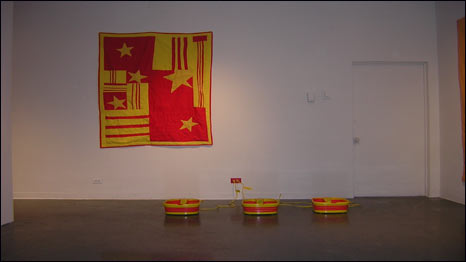
When handling matters of historical and
sociopolitical significance in a country divided such as Viet Nam,
portraying or discussing an objective point of view becomes
problematic. In the fourth of Transnationalizing
Viet Nam,
having such issues became the center for disputes and protests. As
stated in the introduction, “in January [of] 2009, an art exhibit
of Vietnamese American works with the theme of diverse perspectives
as expressed freely in art, F.O.B. II:
Art Speaks,
appeared in Santa Ana, in Southern California” (90). Unfortunately
for the exhibit, the event was closed a few days earlier than
expected due to a growing protest regarding some of the contents
displayed in the exhibit. The most prominent feature of this issue
was two of Chau Huynh's pieces: one being a quilt designed with both
the Southern Viet Nam's flag and the Northern Viet Nam's flag as
integral patterns, and the other being three pedicure basins painted
in the South's former Republic flag colors and patterns. Three points
of interests come to mind when discussing this type of controversy.
The first two issues are closely related; we must first talk of the
sociopolitical motivations behind the protests as well as the efforts
taken and messages sent within the protest groups. The loss of their
country has injured an an entire community which has led to a narrow
perspective on the current U.S.-Viet Nam relationship. With the aging
of the older generation whom carries the torch of legacy and
remembrance of the pain inflicted to them and their families forty
years ago as well as the dialogues that come with the opening of
U.S.-Viet Nam relations, differences in dealing with the current
state of the country and its identity within its two peoples has led
extremists from the refugee group to declare these pieces of art as a
display of Communist takeover attempt. They charge several newspaper
companies and their employees as having been indoctrinated Communist
hoping to break down their community. Justification for their actions
are not the main topic for discussion however as their intentions are
obvious. The true focus lies with the reason for such extreme
measures to counter Communism. For the exhibit as well as the
newspapers which were targeted, no such mentions for Communism is
present; rather, the individuals involved with the decisions that
sparked controversy has history or has family history facing against
the North. So why has this happened then? It is an unfortunate
thought, but those challenged and lost their nation against Communism
have little patience for seeking objective facts or thoughts; once
the line that was silently drawn is crossed, those who crossed it are
declared unsupportive of the community's interests and therefore an
agent of the North. Furthermore, it is fear that primarily drives
their current path as that history is all that those who remember the
loss can claim as their own. That is the reality of the binary that
was created by the division of a people during the Cold War era. The
last topic is what measures the defendants have taken in order to
protect themselves against these acts of aggression. In early cases,
most have tried appealing to the protesters' demands such as the
firing of selected and targeted employees or the closing of exhibits
and galleries. Often do these methods find little traction against
the protester agenda as the damage to the targeted has already been
done which forever stigmatizes the group in whole. What has changed
over the years is the determination of the defendants. Chau and
others feel that their acts to reconcile with the divided history of
the Vietnamese have made progress despite these counters.
Furthermore, these cases often are taken up into the courts and these
red baiting tactics have been ruled under slander due to the use of
personal leaks and attacks to selected individuals. Ultimately, it is
an ironic part of this history as it is a deep, communal fight
against a regime that has led them to use fear tactics to reduce
their losses, and have resulted, in recent cases, open up
opportunities for further dialogue rather than rehash the same
history that has been in a loop for this group for over forty years.
Victoria Vergara:
Chapter 5: Whose Community Is It Anyways? Overseas Vietnamese Negotiating Their Cultural and Political Identity: The Case of Vice-Mayor Madison Nguyen
The chapter begins with council member, Madison Nguyen, at a press conference, where she is faced with a room filled with Vietnamese American journalists who have written critical pieces regarding her performance as a council member. Madison announces her release of her free DVD, where the documentary was "meant to convince the Vietnamese American public not to recall her." The Vietnamese Americans were fighting for political representation within their community, however, they perceived Madison as a communist for not allowing the name "Little Saigon" to be the established name for the district. Madison's father who was a solider for the Army of the Republic of Viet Nam, kept silent for most of her previous campaigns in order for her to be independent and to learn from her own mistakes. However, after accusations of her having relations to communism--that's when Nho Nguyen spoke up and defended her.
Madison accomplished a lot in the San Jose Community. She organized a successful voter registration for numerous Vietnamese Americans and she also waged a campaign against the San Jose police department over a wrongful killing of a Vietnamese American mother, Cau Thi Bich Tran, where her family won $2 million from the San Jose police department. These accomplishments made her a successful city council member. However, the controversy about refusing the name Little Saigon to be the name for the business district, resulted in hateful remarks towards Madison from the Vietnamese American community. They strongly assumed that her refusal to call the district Little Saigon was because of her strong ties to communism. Advocates of Little Saigon believed that that name was suitable because it represented "refugee experience, freedom, democracy, and nationalism. Most of all, it represented anti-communism." In attempt to resolve this conflict, Madison pushed for the name "Saigon Business District" instead in order to appease the public who supported other names such as New Saigon and Little Saigon. However, the protesters still wanted Little Saigon.
As the protests were lingering on, racial tensions were emerging within San Jose. Predominantly Latinos and white as well as other Asian Americans "began efforts to reclaim San Jose as a multiethnic city that should not have ethnically demarcated business districts." People posted racial comments toward Vietnamese Americans on Little Saigon telling them to go back to Viet Nam and that if they were really Americans, they would assimilate to their culture and to cease the protests. To calm the waters, Madison and Mayor Reed allowed the Vietnamese American public to hang banners with the name Little Saigon around the city--the community saw this as a victory, however, they still continued with their efforts to recall Madison. Despite their efforts, Madison was victorious because "she raised twice as much money for her no-recall campaign than her opponents; [and] all the San Jose council members and the mayor supported her."
The chapter also explains that a good portion of the Vietnamese population during the 1975 wave of refugees, were from wealthy and powerful political families. So, when they came to the states, they had a strong desire to lead and to be financially secure. Within the Vietnamese American community, the older generation directed their focus on anti-communism whereas the younger generation, who were born and raised in the U.S., disapproved of their parents and older generation in terms of activism for political and social identities. In conclusion, after months of weekly protests, they have managed to alienate many of the Vietnamese Americans in the Bay Area. "In an unprecedented event in Vietnamese immigrant history, over eight-hundred Vietnamese American professionals, laborers, leaders, and activists calling themselves Our Voice signed an open letter asking for the end of intimidation tactics by the protesters and calling for peace and support for Madison Nguyen."
https://www.youtube.com/watch?v=SRkxGF_qDHI
Chapter 6: Vietnamese Diaspora Revisited
Professor Valverde writes about countless experiences throughout her enlightening book which showcases the Vietnamese American community trying to fight for political representation and social rights. The chapter begins with Phuong Ho, a twenty-year-old international student majoring in math at San Jose State University. In September 3, 2009 an incident occurred where Phoung’s roommate, Jeremy Suftin, put soap on Phoung’s steak. Indeed, this infuriated him so he took a knife and seemingly threatened Jeremy by saying, “In Vietnam, I would kill you over that.” Despite the roommates perceiving this as a casual joke, Jeremy took it very seriously and reported this incident to the police. The police claimed that Phuong was uncooperative and resisting arrest, thus resulting in him getting hit with a metal baton several times as well as getting tasered. “Some of the strikes took place after Phuong was already subdued and on the floor, and he pleaded for mercy during most of this time.” One of the roommates recorded the incident and this incident became a viral issue.
Vice Mayor Madison Nguyen and other Vietnamese community members expressed concern for this issue and demanded justice. However, when the info of Phuong was a Vietnamese national was learned by the community, some of them began to distance themselves from the issue because they feared that they would be labeled as communist. In regard to this issue, because many saw this is a violence act against the police, who abused their power, the Vietnamese Consulate General in San Francisco sought to provide protection for Phuong.
Many immigrants face the challenge of assimilating themselves into American culture while negotiating their places in U.S. society. With the Vietnamese immigrants, “Official Vietnamese representatives in the United States are compelled to sepal in support for their citizens in such cases.” However, “Vietnamese officials have been careful not to criticize the United States and jeopardize diplomatic and financial ties.” According to Valverede, “Vietnamese American lives are transnational.” The people in Viet Nam and in diaspora inevitably find way to connect despite international policies discouraging such connections. Through the digital and virtual world, people in Viet Nam and some Vietnamese Americans are able to virtually organize social movements, create art, and find political representation.
In this chapter, Professor Valverde lists some of her profound moments in her research. Throughout the book, she divulges the causes of events and what the motive is behind them. For instance, she describes Vice Mayor Madison Nguyen’s controversy over the name calling of the Business district in San Jose. The outcome of this event, “Permanently shifted the dynamics of Vietnamese American politics in diaspora.” Professer Valverde even explains that during her fieldwork in Viet Nam, she found out how “transnational connections” are disguised, because if these connections were detected by the Vietnamese government, the flow of exchange will stop and those in on these various connections will be confined.
Indeed, the Vietnamese Americans had definitely had their historical hardships throughout the war and even up till now—trying to find their national identity within the United States. However, with people like Vice Mayor Madison Nguyen, writers/bloggers like Hoanh Dinh Tran and Tin Le, and Our Voice association— they all provide support for the Vietnamese American community to be appropriately represented.
https://mbasic.facebook.com/cdnvqgga?v=timeline&filter=0&timecutoff=1392410698§ionLoadingID=m_timeline_loading_div_1396335599_0_36_&timeend=1396335599×tart=0&tm=AQCYCohVglkxFy3S